July 3, 2026 · 8:17 AM
Valar's nuclear bet is a factory problem
No Priors' conversation with Valar Atomics founder Isaiah Taylor reframes AI's energy bottleneck as a reactor manufacturing problem. The article explains why Valar emphasizes tick rate, passive safety, DOE test pathways, and vertical integration over another perfect paper reactor design.

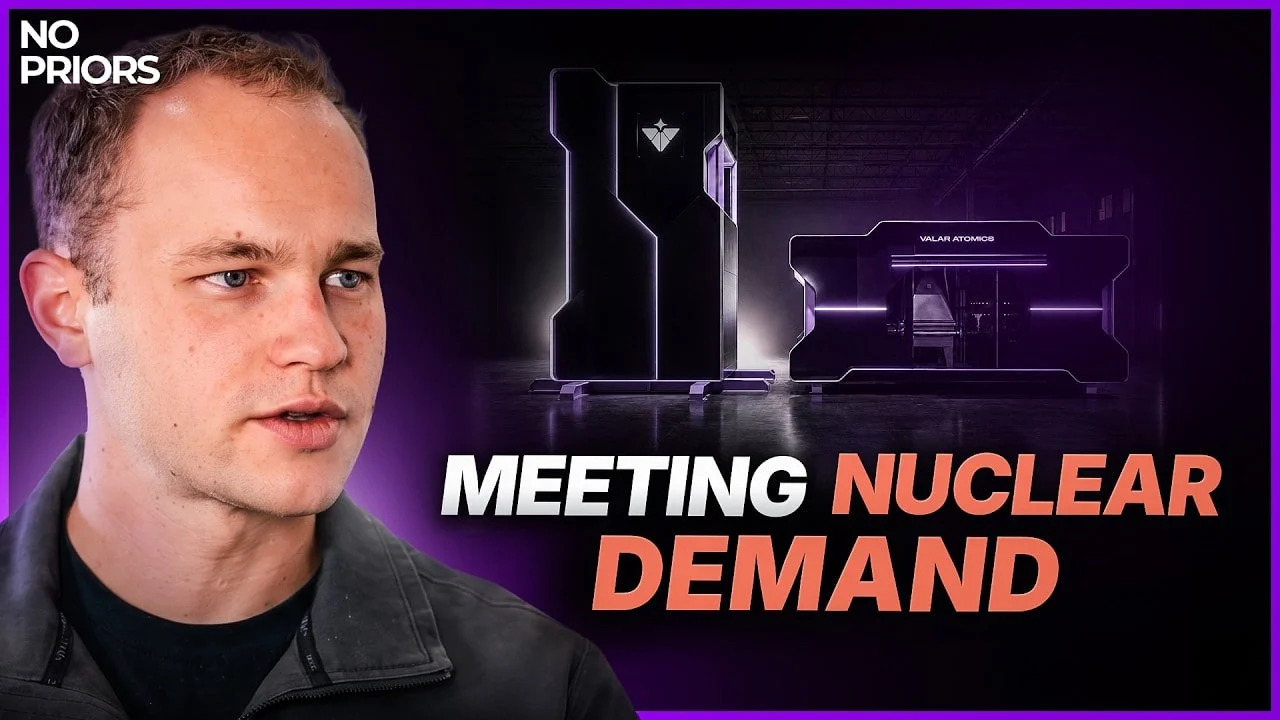
A nuclear startup powering an Nvidia Blackwell chip makes for a neat demo. The more interesting claim in Sarah Guo's No Priors conversation with Valar Atomics founder Isaiah Taylor is colder and more operational: nuclear will not become an AI power source because someone designs a perfect reactor on paper. It will matter if a company can make reactors behave like manufactured hardware, then keep shortening the interval between one working machine and the next 1.
Loading content card…
The thesis: nuclear needs a tick rate
Taylor's core distinction is between nuclear as a design problem and nuclear as a hardware execution problem. In his telling, much of the industry became a modeling and simulation business because companies needed data to satisfy regulators, but needed an operating reactor to produce that data. Valar's answer is to build, test, and learn from physical systems rather than keep refining "paper reactors" 1.
That framing explains the phrase Taylor returns to throughout the episode: tick rate. In software, a fast feedback loop might mean more builds, tests, or deployments per day. In Valar's vocabulary, it means the time between consequential reactor milestones. Taylor says the company took 2 years and 4 months from incorporation to its first atom split, then roughly 7 months from its Project Nova criticality to the Ward 250 reactor, and wants that interval to fall toward minutes over time 1.
That is an aggressive claim, but it is not just a slogan. The episode is useful because it forces AI listeners to translate the usual "power bottleneck" story into a manufacturing question. If AI demand keeps pulling on electricity, the relevant question is not only who owns generation assets. It is who can lower the cost and cycle time of adding firm power.
Why Valar thinks the old nuclear playbook stalled
Taylor's historical argument starts with Three Mile Island but does not end there. He says the 1979 accident damaged public trust, even though nobody died and no radiation dose reached the public in the way many people imagine. The deeper problem, in his view, is that once the United States stopped building reactors at scale, it lost the large civil-infrastructure muscle that made the 1960s buildout possible 1.
That leads to a more specific industrial thesis. Taylor argues that the United States is now better at advanced manufacturing than at giant bespoke infrastructure projects. So the modern nuclear opportunity, if it exists, should look less like one-off megaproject construction and more like repeatable equipment production 1.
Outside reporting gives the setting for why this episode landed now. Valar's Ward 250 reactor reached zero-power fueled criticality in Utah in June 2026, and World Nuclear News described the reactor as part of the US Department of Energy's Reactor Pilot Program, whose goal was to get at least three test reactors to criticality by July 4, 2026 2. KSL reported that the Ward 250 components had been airlifted by three Air Force C-17s and that the site was in Orangeville, Utah 3.
The regulatory nuance matters. Taylor is not saying commercial nuclear licensing suddenly became easy. He is arguing that the Department of Energy testing pathway lets companies gather empirical reactor data before they approach the Nuclear Regulatory Commission with a mature commercial deployment case 1. That is a narrower claim, and a more credible one.
Safety becomes a scaling constraint, not a branding claim
The strongest technical section of the conversation is not the Nvidia demo. It is the discussion of decay heat, passive cooling, and consequence reduction. Taylor explains that traditional light-water reactors need active cooling after shutdown because recently split atoms keep producing decay heat. His argument for Valar's design is that scale requires a reactor that remains safe even when operators and active systems fail 1.
This is where the episode's safety vocabulary becomes concrete. Taylor says advanced reactors should reduce risk by lowering the consequence of failure, not only by reducing the odds of failure. In the Ward 250 demonstration, he describes turning off electrical supply, circulators, and safety pumps after a scram to test whether the reactor can passively remove heat through its geometry and materials 1.
Valar's own website says its high-temperature gas reactor design uses TRISO fuel, graphite moderation, and helium coolant, and positions the company around grid-independent products such as data center power, hydrogen, industrial power, and clean fuels 4. Those details are not decoration. They explain why Taylor keeps linking safety to speed. If a design needs less active intervention after shutdown, the company can plausibly argue that it is a better candidate for repeated manufacturing.
The caveat is that one test reactor does not prove a scaled fleet. The episode includes real reliability issues: helium circulators, heat exchangers, graphite moisture, purification systems, and rust risk all come up in the plant tour 1. The better reading is not "Valar solved nuclear." It is that Valar is trying to move nuclear into the same empirical loop that software and aerospace founders already understand: build the system, expose the failure modes, then make the next version less fragile.
The AI angle is price, not just supply
AI appears in the episode in two ways. The obvious one is theatrical: Valar says it powered an Nvidia Blackwell system directly from the reactor and hosted a website from that chip while the reactor was running 1. The more important one is economic. Taylor argues that energy demand is set by price. If energy gets cheaper, new demand appears.
That point separates his pitch from the standard data-center power story. In the near term, data centers need firm electricity, and Valar wants to supply it. But Taylor's larger claim is that cheaper energy changes the cost structure of physical production. As AI and robotics convert more human labor into machine work, he argues, energy becomes a larger share of the marginal cost of making goods 1.
This is speculative, but it is coherent. If AI systems make factories more automated, then the cost of electricity starts to matter beyond server farms. A cheap, dense, reliable energy source would not merely keep GPUs online. It would make automation cheaper in steel, fuels, chemicals, logistics, and other energy-heavy sectors.
The unresolved question: can a startup verticalize nuclear?
Taylor's answer to high nuclear costs is vertical integration. In one example, he says Valar accepted expensive off-the-shelf control electronics when speed mattered, but built its own reactor protection system after a vendor quoted about $5 million and a two-and-a-half-year timeline. He says Valar built a working version in six weeks for about $400,000 1.
That anecdote captures both the appeal and the risk of the episode. The appeal is obvious to anyone who has watched a stagnant industry protect cost structures behind specialized vendors. The risk is equally obvious: nuclear is not SaaS, and verticalizing safety-critical systems invites scrutiny even when the engineering is sound.
The useful takeaway is not that every nuclear startup should behave like SpaceX. It is that the AI power conversation has been too shallow if it treats energy as a procurement line item. Taylor's case is that cheap nuclear power is downstream of reactor manufacturing cadence, regulatory test paths, passive safety, and a willingness to attack every bottleneck in the stack.
For AI practitioners, that changes the question. Instead of asking only whether nuclear can power data centers, ask whether any company can make nuclear iteration fast enough to meet AI's compounding demand. Valar has produced a striking early proof point. The hard part is whether its tick rate keeps improving after the demo lights turn off.
More from this channel
Related content
- Sign in to comment.